

Study with the CSTB: Assessment of the Impact of Green Walls on Urban Temperature
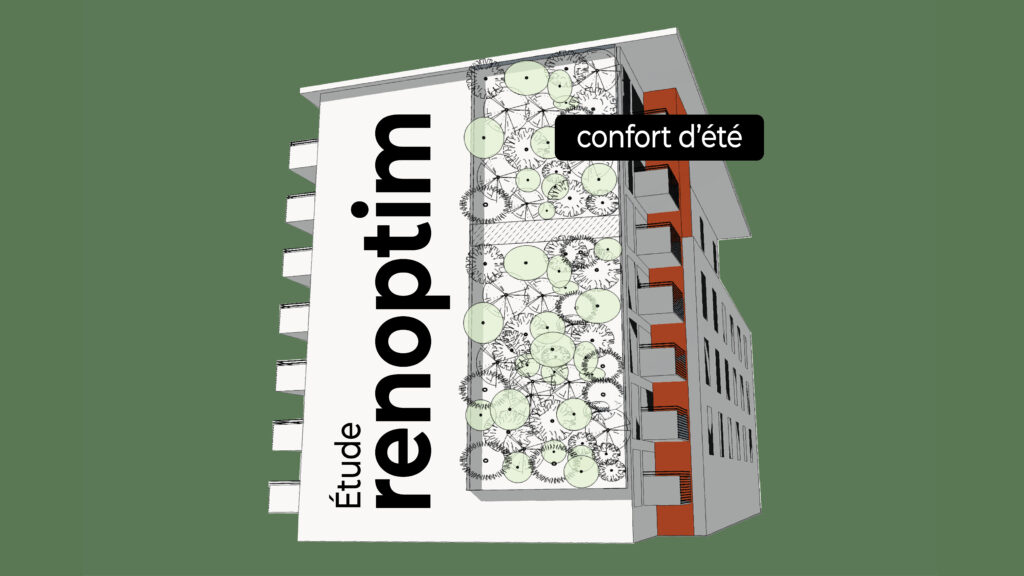
Les murs végétalisés sont souvent salués pour leurs nombreux avantages, mais qu’en est-il de leur efficacité réelle en matière de régulation thermique ? Une étude récemment réalisée par TRACER en collaboration avec le CSTB fournit des réponses concrètes à cette question. Voici les résultats de cette analyse approfondie et leur portée pour l’avenir de la végétalisation urbaine.
Contexte de l'étude
En 2022, TRACER a rejoint le projet RENOPTIM, piloté par le CSTB, visant à évaluer l’impact de la végétalisation sur les îlots de chaleur urbains. Ce projet a pour but de mesurer comment les solutions de végétalisation, comme les murs végétalisés, peuvent contribuer à réduire les températures en milieu urbain.
En avril 2023, nous avons mis en œuvre cette étude en installant un mur végétalisé sur le pignon Sud d’un bâtiment collectif de six étages à Sens. Ce mur, équipé d’une isolation thermique par l’extérieur et d’une lame d’air, a été scindé en deux parties distinctes : l’une arrosée régulièrement et l’autre laissée sèche. Cette méthodologie visait à comparer l’effet de la végétalisation sur la température des surfaces et sur l’environnement immédiat.
Résultats clés de l'étude
Température du Substrat
Les résultats montrent que le mur végétalisé a un impact significatif sur la température des surfaces :
- Substrat Arrosé : Lors des journées ensoleillées, la température du substrat humide peut être jusqu’à 17 °C inférieure à celle du substrat sec. En moyenne, sur toute la durée de l’été, la différence est de 3,5 °C.
Impact sur les Îlots de Chaleur
L’étude a également mis en lumière l’effet de la végétalisation sur les îlots de chaleur :
- Lame d’air : La température de la lame d’air au niveau du demi-mur humide est jusqu’à 10 °C inférieure à celle de la lame d’air du demi-mur sec lors de pics de chaleur. En moyenne, la différence est de 2 °C sur l’ensemble de la saison estivale.
Observations et conclusions
Confort Estival à l’Intérieur des Logements
Les résultats montrent que le mur végétalisé et la lame d’air sont plus frais lorsque le système est arrosé. Cependant, l’impact à l’intérieur des logements révèle des nuances importantes. Le mur végétalisé a été installé sur un pignon déjà doté d’une isolation thermique par l’extérieur. Par conséquent, bien que notre solution contribue à rafraîchir le bâtiment et à réduire les îlots de chaleur, son effet sur le confort intérieur est moins significatif. Il est crucial de considérer les spécificités thermiques de chaque logement pour une évaluation précise.
Impact Global de la Solution Vertiflore
La solution Vertiflore a montré son efficacité dans la réduction des températures en milieu urbain, tant sur les bâtiments que sur les îlots de chaleur. Néanmoins, pour maximiser les avantages du mur végétalisé, il est essentiel de prendre en compte l’ensemble des facteurs thermiques de chaque site.
Pour des détails approfondis sur cette étude et ses implications, nous vous invitons à consulter l’article complet publié par Profeel en suivant ce lien : https://programmeprofeel.fr/journal/mur-vegetalise-un-test-in-situ/